It was well evident from our first record we had an affinity for your Harmonic Minors and Phrygian Dominant scales, and some background might be helpful for anyone to understand why that is.
Alex (Arnaoutoglou) and Chris (Gioldasis) both have roots in Asia Minor, historic Ionia. Alex‘s last name derives from Ar·naut (ˈärˌnau̇t = Albanian) plus the suffix -uglu meaning ‘son of’; and the latter’s last name translating to Stone-Paved Road or Rocky Road from Turkish yol taş; and they both happened to entertain Anatolian modes and a bit of Rebetiko. I was myself a great admirer of Rebetiko as we had previously been exchanging with friends cassette tapes of 1930’s recordings that took place in less sophisticated versions of the contemporary coffee shops found in Amsterdam today, mainly to laugh with the ad-lib catchphrases of the doleful, yet high as space shuttles performers. However, the emotive content, the somber mood, and the directness/simplicity of the delivery left a mark on me.


Around the time we were finalising the first album Alex‘s father who also happened to be in a rock band in the 60’s that were doing originals(!), was visiting modern day Turkey in search of the old family home in Χριστιανοχώρι (Christianochόri – Christian Village), modern-day Kadiköy (A village near Pergamon, not to be confused with the homonymous Istanbul district); and he brought back from his travels the non-purpose-built, decorative mini darbuka you can hear in some parts of the album.
Relatedly, that village was uprooted twice—first after the end of the Balkan Wars in 1914, and ultimately and definitively in 1922 following the population exchange as prescribed on the Lausanne treaty with the conclusion of Greco-Turkish Wars creating a new class of undesired ones mainly on the Greek side as they had to accept a massive influx of displaced people (a whopping additional 25% of the population in Greece, whilst Turkey only had to accept a quarter of that number, something insignificant in comparison especially when taking into account that Turkey is a bigger country in terms of land mass that also happened to have a considerable in size empire up till a few years before that point, sponging off resources from various territories including Greece) typically in the port city of Piraeus introducing new levels of poverty in a country whose economy suffered following the preceding wars.
This predicament culminated the counterculture the urban folk of Rebetiko was communicated within, during the late 19th / early 20th century. That new marginalised, disfavoured, low-life, and largely drug-abusing group expressed their frustrations through Rebetiko songs that contain ‘invaluable references to the customs, practices, and traditions of a particular way of life, but above all the practice is a living musical tradition with a strong symbolic, ideological and artistic character.’; as UNESCO‘s entry on Rebetiko‘s 2017 (12th Session of the Committee) inscription on the Representative List of the Intangible Cultural Heritage of Humanity informs us.

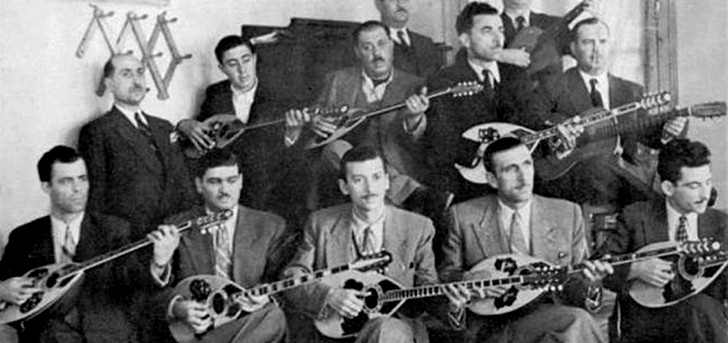

Aside from the musical ‘ways’ (or roads for δρόμοι, to describe scales that appropriated an approximation of how Byzantine Echos would translate on fretted instruments designed for the 12-tonal Western musical system), the lyrical moods and themes have also influenced our writing as many of our songs are dramatic and are revolving around psychological realism. Rebetiko is characterised by its pessimistic lyrics around themes including love, motherhood, passion, migration, persecution, poverty, unemployment, misfortune, social injustice, prostitution, and drug abuse.
The Opening and Main Musical Motifs
Once we had a barbeque at Chris‘ mother’s house the Saint happened to be also attending as my plus one as he was briefly back from a holiday from Venice where he was studying at the time, and a few of us would be taking turns having a go at an acoustic guitar that was there.
Chris played what’s far from a Rebetiko standard (more like a song for the insiders) Mes Tou Mathou ton Teke the title translating to ‘inside Manthos‘ hash den’ in English.
A “τεκές” (tekes) is a place where people, particularly in the early 20th century in Greece, would gather to smoke hashish, often accompanied by music and a relaxed social atmosphere. “Μάνθος” (Manthos – the Greek equivalent of Matthew) is a person’s name. So, the phrase refers to being inside the hash den owned or run by Manthos.
A few days after I attempted to figure it out from memory, and the intro to Homeseek Dark Blues came up while trying a few different things.
I brought all parts to the practice room and we made some last moment additions directly influenced by the covers we were trying at the time. Marios proposed we tweek the timing of the hooks’ riff to vaguely resemble the way Nirvana do In Bloom‘s intro and I thought I’d add a climactic riff like Massive Attack do on Angel or Dissolved Girl for that matter, and I wanted that that to be quite distinctive like what Martin Gore does on Depeche Mode‘s Precious‘s middle section in an attempt to make it as effective. Nothing like a bit of good old informal learning in songwriting, eh?
Lyrical Content
The lyrics revolve around themes including nostalgia, longing for a state of contentment, cultural shock and cultural bereavement.
That mood is largely associated with the whole album of which the W on the cover symbolises the W curve that describes the Phases of Culture Shock (that is perpetual as the infinity/ouroboros symbol on the bottom of the artwork signifies, but where it would be vertical it forms the numeronym W8 for Wait – or the Endless Wait that Makes us Who we Are, where the lemniscate would be imagined with a 90 degree tilt to it).
To avoid duplication you can find a few things contemporaneously discussed on nostalgia by clicking here.
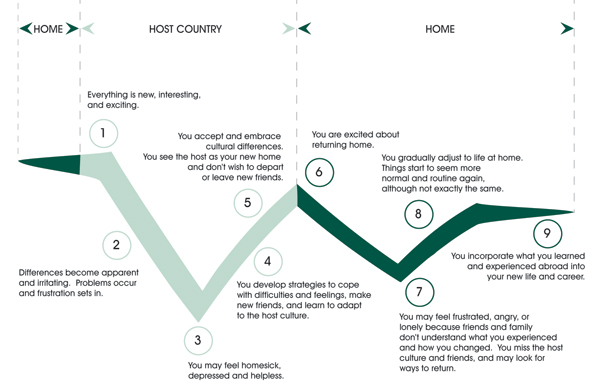
Essentially the models that describe culture shock are about what is experienced by an individual who moves or is displaced, and the events around the album involved a lot of the emotional fluctuations people experience when adapting to a new culture (and then re-adapting to their home culture) the above graph illustrates. Some of the common stresses possibly experienced by said individual would include social bitterness, unrealistic expectations, and difficulty making friends.
Shortly after the release of In Consequence, when we were working on the songs for the Wait album, Alex, Dim, and I considered moving the band to the UK. In jest, a friend who was prompting for similar conversations at the time, pointed out that while we had the “device,” we had no “sockets” to plug it into, suggesting that we at least relocate to Athens.
When the lineup changed, the Saint was eager for us to move to Newcastle, where someone we had recently got acquainted with happened to be already living, for his own reasons. Round about the same time, a then prospective manager was encouraging us to move to London but it would later turn out I wasn’t enough of an opportunist to stand living there. Meanwhile, Marios, despite his best efforts to find a job, was unable to stay and had to move to Stuttgart to be with his sister. With all this happening, not being willing to lose momentum by wasting one year on mandatory military service I was ethically against to begin with, it felt it was a good idea to move the core of the band to the UK.
Growing up immersed in UK culture—everything from The Wombles and Peter Rabbit, to the The Benny Hill Show to John Milton, William Blake, William Shakespeare, Bram Stoker, Charles Dickens, the Monty Python, The Two Ronnies, Blackadder, Led Zeppelin, Black Sabbath, Iron Maiden, and countless other British bands and writers—assimilating didn’t feel like much of an effort (Greece being an informal protectorate of the UK, sharing royal family members, being part of the allies, and later being in the same sphere of influence in the cold war). Additionally, I already had a taste for beer and gin and a naturally phlegmatic, stiff-upper-lip disposition.
My move was conscious and can be seen as a bit of a different experience to that of an immigrant in the back of a truck, following a month-long journey in a ship. But despite having essentially legally emigrated, I have still in a sense sought artistic and political asylum, as there were more things I found attractive about the social contract as observed in the UK, as opposed to what I already had got to know in Greece.
Whilst I have never intensely experienced cultural shock due to the above reasons and the fact that I’m good at building meaningful relationships with others easily, I have intensely experienced the effects of reverse culture shock. It took me 9 months to a year to go back after relocating, and I found the process of readjusting to my home culture after living in the UK impossible. It always takes me about a week to switch off and relax whenever I go back, partially from feeling disengaged and alienated.
I reckon I experienced a milder, scaled-down version of ‘culture shock’ when I was 10 y/o’. Despite moving just five miles away to a village on the outskirts of Larisa, adjusting was surprisingly difficult. I attended a school where I was considered the top student and a high achiever, even though I often played with my GameBoy under my desk. The academic standards weren’t particularly high (I don’t know how to express this without coming across as arrogant or judgmental), and not at all challenging. As a result, I quickly became the teachers’ favourite, which led me to rest on my laurels. This complacency later impacted my academic performance, especially when I entered sixth form. By then, I had developed the habit of doing very little, relying on the perception that I was naturally above average in intelligence and neglecting consistent study. This attitude inevitably caught the attention of girls and caused unnecessary tensions with some of the lads, adding a Jimmy Stark-esque twist to my teenage years.
A lot of the above I have in common with my mate Liam in terms of similarity in early formative experiences, who became one of my best friends here, and who is now actually living in Colombia. From life experience, I’m convinced (perhaps there’s a Magical Thinking element involved in that belief, I don’t know) that people naturally find others who are similar to themselves through subtle, subconscious observations of verbal and non-verbal cues. It could be that from the way others are presenting, we can potentially instinctively sense what they have been through, who can offer understanding, and who provides the psychological safety to open up or serve as a Big Other—if we’re brave enough to first admit our own truths. On a related note, another friend of mine, who moved from Poland to Greece, once told me before I moved that I’d meet the same kinds of people wherever I go. And boy was he right?
Marios also appears to have adapted well in his new reality, being fully orientated in person and as opposed to a prospective retailer for Leroy Merlin, a role he did not end up getting, he is now working as an Environmental Scientist in an area he is deeply interested in and sensitive about. Funnily enough, another Greek Environmental Scientist I know always says he’d be slicing ham at a supermarket had he had stayed back in Greece (Not that this would be at all discreditable, but it admittedly requires less mental strife or intellectual labour in comparison).
Perhaps the Saint who had to go to Italy and study in his late teens right after school and then decided to come here before his degree finished, had a slightly different experience, as his cultural identity would have inevitably been impacted by that.
These changes also affected Damos, (whose parents are also displaced Pontic Greeks as part of the broader event mentioned above by the way) who was really invested in the project but had no imminent plans, nor intention to move, and that led him to refocus his priorities, notwithstanding the fact that he kept on working on the album. Despite the band had The Saint coming from Venice for gigs before, this was perhaps for Damos a change he was not prepared to negotiate or reconcile with, although he would later also attempt to relocate.

All the above matters loosely inspired the song and led to the creation of the songs’ lyrics, along with the nostalgia for comfort that might not even experienced in the first place. Longing for a utopia, or an idealised condition that is demystified once confronted, and that can also be compared to comedowns after substance misuse, following that eagerness for the comfort in feeding an addiction, or even the highs of a toxic relationship one could be hooked on, amongst other things… You get the drift!
The Song’s Title
The title is an obvious nod to Bob Dylan‘s Subterranean Homesick Blues. I grew up with little musical influence, as my parents weren’t particularly into music—despite both having been involved in traditional dance groups in their youth in a semi-professional capacity. My exposure to music was limited, mostly through older cousins who were into acts like The Doors, The Cranberries, U2, and Guns N’ Roses. I was a near blank slate.
That changed when a bar my father ran shut down during my pre-teens, and he brought home a few records. Among them was Maiden Japan by Iron Maiden, which caught my eye because of its edgy cover. But the record that truly left a mark on me was Bob Dylan’s Bringing It All Back Home. When my brother and I played the opening track, we were blown away. I had no reference at that point—I didn’t know if it had been released in ’65 or the week before, and it felt entirely relevant.
We quickly learnt and memorised quite a few of the lyrics, not just from Subterranean Homesick Blues, but also Maggie’s Farm and Mr. Tambourine Man. This brilliant piece of protest rock, steeped in Beat Generation nostalgia, left a lasting impression. In a way, it parallels our song—capturing a sense of nostalgia and teenage angst that the Beatniks themselves never fully had the chance to experience.

Playing the Greek Blues
Enjoy our Mediterranean blues for the culturally homeless, live from the O2 Academy Newcastle.
Rebetiko Directed by Costas Ferris
Finally, for those who are interested to dig further into Rebetiko, I’m suggesting you should watch the phenomenal homonymous movie directed by Costas Ferris that offers a useful insight into the aforementioned culture.
You can find it with English subtitles below:
Peace and Love,
Thanos
Useful links for immigrants and asylum seekers in the UK:
https://actionfoundation.org.uk/
https://www.nrpfnetwork.org.uk/
https://www.refugee-action.org.uk/
https://jcwi.org.uk/
https://www.migranthelpuk.org/
https://asylumaid.org.uk/
https://www.project17.org.uk/
https://rightsofwomen.org.uk/
https://settled.org.uk/
 Phaseship - The Phase Archives
2 Comments Add yours