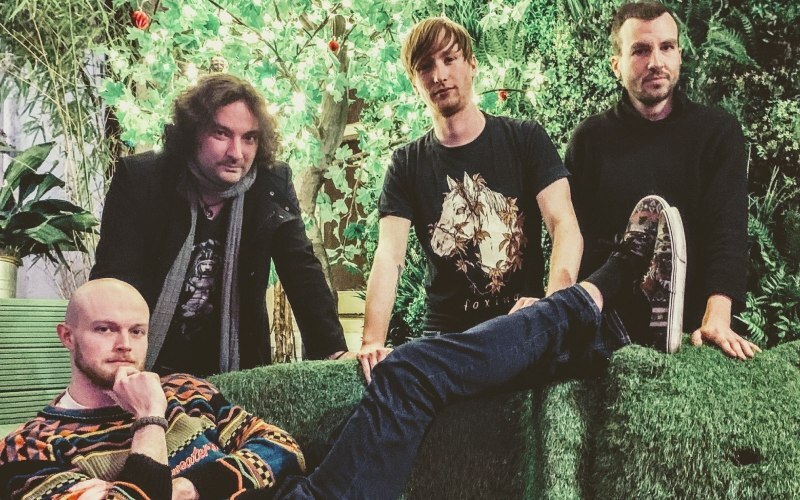
A bold journey from the long-suffering plains of Thessaly to the “Newcastle” of the north, in the infamous island that has nurtured so many musical idioms—this could well be the headline of the story of Phase. The book behind that headline, however, we leave entirely in the hands of the band’s founder and driving force, Thanos Grigoriou, in an in-depth, river-like interview that traces every detail of the “Larisa–Newcastle” route, with a wide-angle, panoramic scope.
So let us go far back and unravel the thread from the very beginning. Remind us when Phase were formed, who the founding members were, and what your musical goal was at that point in time: what kind of music did you want to create, and which themes did you want to explore?
Hello George, and thank you for the opportunity to present our work through the pages of Soundcheck Network.
I will deliberately elaborate a bit, because the thread is rather tangled, and a more complete overview may be of interest to some readers; especially since the focus of these appearances is the return to our roots.
The first attempt to build what would be called Phase took place 20 years ago, with George Agnantis on drums, Vasilis Valozos on guitars, Apostolis Pazaras on vocals, and myself on the bass. As we had defined our sonic palette back then, it was atmospheric, guitar-driven rock with progressive and psychedelic extensions. Music we were listening to together as a group at the time included A Perfect Circle, System of a Down, The Doors, Anathema, and Katatonia, among others.
After several rehearsals, we turned down a live show with Deadsoul Tribe due to our perfectionism and our belief that we were not ready. As a result, we alienated Vasilis, who held a different view of how we should proceed, a stance I have regretted ever since, regardless of the tragic irony that the live show was eventually cancelled anyway.
We then recorded a demo with Thomas Paparizos on guitars shortly afterward, but this addition merely accelerated the trajectory toward dissolution that we were already on. We ended up pursuing independent paths, with George attempting to move forward using the same new material, much of which I had written, replacing the tracks that had previously been composed mainly by Vasilis (if I recall correctly, we also kept some structures from the old songs as blue prints, in which the guitars were replaced by Thomas), while I retained the band name as its “godfather” and gathered new material, testing it with various members until I met Dimitris Lytras and Alexis Arnaoutoglou at the Uni where the three of us studied the same course.
Thus, together with Christos Gioldasis, we formed the second lineup. With its members, some more than others, we worked on the first album, with Dimitris Athanaselos briefly taking a seat behind the drum kit. Coincidentally, Alex had previously (in the interim before we met) helped George with the old material, without that effort developing any further.
Our initial goals were to write music that we ourselves would want to listen to and, to some extent, to feed the vanity we had at the time, which, of course, is not the healthiest motivation when it comes to creative expression, but it is not unusual for people of that age. If I am honest, beyond the fact that we were quite competent as players, I think we lacked the background and experience to produce anything truly substantial at that particular moment.
Later on, through discussions within the newly formed lineup, we defined our goals and the approach by which we wanted to try to achieve them, creating a new code of communication among us. Eventually, I took on vocal duties, which felt more natural since I was writing the lyrics and was less self-conscious about doing so than the others. We also did not want to expand the lineup with additional members, having come to understand the difficulties of maintaining multiple and complex relationships within a group at a healthy level.
Many names have already been mentioned that passed through Phase, but if one considers the fact that—especially in Greece—it was practically impossible for an unfashionable musical act with a distinctive guitar-driven rock sound to become a sole means of livelihood, and that members’ priorities can change, while few people have the luxury of persistently devoting significant time to an artistic project with many moving parts, no matter how passionate they may be about it, then changes in the lineup do not seem all that dramatic. This is particularly true when the longevity of Phase is taken into account.
In the beginning, the lyrics were largely based on poetry by George, which I translated into English and supplemented or expanded wherever I felt it was appropriate. They were mostly abstract, dealing—albeit vaguely—with various psychological states, loss, hope, redemption, etc. The lyrics I later worked on for the band are more specific and engage with different aspects of the human condition, while still retaining their capacity for multiple interpretations. Technically speaking, I would describe them as a balanced blend of symbolism and intellectual aestheticism.
At some point, you move to the Great Albion. When did that happen? Explain the circumstances behind the decision, how much it had to do with the future of Phase, and what changes this decision may have brought to the band’s lineup.
This happened approximately 11 years ago. The decision was very closely linked to the band’s evolution, and it had been mentioned as a possible future step even by members of earlier lineups, though it had not previously matured within us as a fully formed idea. The then-accountant of Pulp, Jarvis Cocker, and Kaiser Chiefs, among others, had ambitions to open her own management company and “earmarked” us, as they say over here—though “had her eye on us” might be the more appropriate expression in this case. She traveled to Greece to see us live and invited us to London, where I personally spent a considerable amount of time doing acoustic performances, testing the scene and assessing whether the country would be suitable for relocating our base, as we had discussed among ourselves.
Coming from a relatively small Greek city, I found the pace of life there prohibitive. I came into contact with many people with connections in the industry, but as a city it gave me the impression of being a melting pot of opportunists from every corner of the world—something that works for some people, and not for others.
As a result, I set my course for Newcastle, which became an option because of the city’s practical size, as a friend had advertised it to us, and—if I’m being honest—because of its similarities to Larissa, with what I consider a very good quality of life and friendly people. It was there that we were approached by Jonny, the then-manager of Crippled Black Phoenix, who also believed in us wholeheartedly.
Other factors behind the move included the encouragement—upon his departure—of our then-drummer, Marios Papakostas, who had been unable to find work in Larissa despite his efforts and eventually moved to Germany. There was also the fact that I saw the whole endeavor as a legitimate way to avoid military service, being a lifelong pacifist, and having had recent experiences visiting Lebanon and Syria for concerts—where the government resigned in the former and a civil war that has yet to end broke out in the latter. It felt utterly absurd that people we had met and built relationships with while working together on those concerts were going through all of this and everything it entailed. It was as though we were reliving, in a way, a flashback to the 1990s, when buses carrying children who had fled the Yugoslav wars would arrive at schools.
The relocation was not as smooth as we had expected, and due to various obligations and obstacles it happened in a fragmented manner. With everyone’s consent, we performed live shows with various touring members whenever that was necessary.
In hindsight, the decision was made far too hastily, and the move created a certain rift, as well as giving rise to situations that admittedly set us back somewhat—on top of the fact that all of this coincided with an issue that caused incalculable damage, and which I do not consider appropriate to elaborate on here.
And that is how we arrive at the present day…
To formally complete the historical context of the band and bring us to the present, who are Phase today, and what is the connection with the past in terms of memebers?
Vasilis Liapis has been in the band since 2011 (and was a strong supporter of the move to Newcastle), and we had already been playing music together for ten years prior to that point. However, he was studying in Venice, and it simply wasn’t practical to do anything with Phase earlier on. Damos Charcharidis now participates occasionally as a kind of satellite member, due to pending matters that led him to return to Greece, although he was actively involved from 2011 until 2019, shortly after his departure from the island. In fact, I had originally approached him about collaborating with the band back in 2006 or 2007, but that attempt proved unsuccessful at the time. The lineup is completed by Alex Fagan on bass and Jak Kelly on drums, both of whom are respectfully and gladly giving up their places to former members in two of the three celebratory shows in Greece, due to the nature of the project.
To finally move decisively into the present, it would be vital for you to give us your own description of Phase’s music, as you stand on the verge of your third album. Of course, a comparative approach with the previous releases would be more than welcome, in order to give us a clearer sense of the band’s evolution.
Indeed, we have almost completed all the material for the album, which we are currently working on in our own space. Musically, it explores similar paths to the previous two records, and the songs are governed by the same introspective mood that characterises the rest of our work.
I still have no clear idea how our sound should be labeled, but I think it lies somewhere between post-punk revival and alternative metal. If I had to define it through examples, I’d say it’s fairly close to Smashing Pumpkins, Alice in Chains, and A Perfect Circle. As far as the former are concerned, although I never actually listened to them, many people compare my voice to Billy Corgan’s—but we’re probably just making the same failed attempt to imitate the vocal fry of Mick Jagger or Van Morrison during vocal outbursts. Strangely enough, I do find certain similarities in our music, and although we share many common influences, I wouldn’t say that alone directly justifies such comparisons. Damos attributes it to the fact that I was a “closeted fan” of Placebo, who clearly draw influences from them, which seems like a more reasonable explanation.
I think there are some prog/crossover elements in our sound, with subtly placed mixed time signatures and unconventional structures in certain parts. When one of our tracks was included on a sampler by Prog magazine, it received a very positive response, which supports this view—although that same audience also embraced Anathema’s music, despite the fact that they are by no means purely prog. It’s a fairly open-minded audience that buys records and merchandise, financially supporting bands; unfortunately, however, it is also aging and not really being renewed.
This time around, we have placed a bit more emphasis on sound, in order to make listening a more enjoyable experience—though not to the point where immediacy is lost. That is, it won’t be a major departure from punk and lo-fi aesthetics, but we will try to treat the songs as fairly as possible so they can emerge in the best way they can.
The new material once again has the heterogeneous tendencies we’re known for, but it makes sense within the context of the album and is clearly more mature—just as we like to believe we ourselves have finally become. It is guitar-driven rock, with some electronic, blues, folk, and Middle Eastern elements.
I should also mention at this point that we are reworking the production of our second album, which coincided with the change of base. Due to circumstances, Damos—who did an incredible job with its arrangements—also had to shoulder the entire burden of production during the final stages, and was left alone, unsupported and isolated, to pick up the pieces of our wreckage because of the situations that arose.
Living in a time filled with very rich—though mostly unpleasant—stimuli, it would be interesting to hear about the themes of the new album, as well as the overall impact of what is happening around us, both locally and globally, on you as musicians and as people.
The reality is truly frighteningly discouraging, and one would expect that we should have moved beyond all this by now. Naturally, we couldn’t help but include an anti-war track on the album. As I explained earlier, we are quite sensitive when it comes to this issue.
Related to that, we had agreed on a tour in Ukraine and Russia with a Ukrainian booking company during the pandemic—but that never came to pass. I won’t even begin to talk about Israel–Palestine, or list every war currently happening beyond our immediate neighborhood. It is genuinely tragic that in 2024 we find ourselves in this situation.
The central idea of the album revolves around the fact that we are all products of our environment, as well as around familiarity—which often breeds contempt when it comes to relationships—and familiarity in relation to mapping personal preference within all of us. Some tracks deal with social injustice, inequality, and models and mechanisms of dependency, among other things. Like our previous work, it may not be music for every moment—at least not for everyone—but perhaps only for those who enjoy being challenged. Or, better yet, entertained. And I don’t mean that in an elitist way at all, despite my obvious tendency to overanalyse or over-intellectualise things…
Art is fluid and changes as society changes, along with the means through which it is created and reproduced. If the majority of people now demand content lasting only a few seconds for TikTok, that automatically shapes the industry as well. Earlier on, we had only digital singles—just as things once began with small discs, whose physical size determined the standard length of a pop song, with the album being a collection of those, until materials changed and a 12-inch vinyl came to define the duration of an album.
Those of us who grew up with great rock albums naturally tend to do something similar. For Beethoven, perhaps that would have been the equivalent of TikTok.
Art exists to reflect whatever reality it inhabits, and when that reality is unpleasant, as you describe, there can only be a tendency toward corresponding analyses. It also functions as a mode of expression that reveals reality, offering up the artist as a symbolic sacrifice, in the form of exposure—without the opportunity to hide within this almost exhibitionist act—thus becoming a tool for the recipient, who uses it to judge and compare. It offers an honest viewpoint, shaping public opinion much like the chorus in a tragedy.
Even if the artist wishes to hide, they can do nothing about the subtext embedded in their work—something they themselves may often be unaware of, whether it is text, image, or anything else. This meaning is frequently decoded intuitively by the audience, who—provided they themselves do not wish to hide—perceive every truth and every motive. When all messages are intentional, we are then speaking of what many philosophers would call “higher art.”
The notorious “Island” has a vast musical tradition and has always been a birthplace of movements and idioms, though these developments usually went hand in hand with a music press that had its favorites and its damned. What are today’s dominant trends, as you experience them firsthand, and what room is there for music like yours in the environment in which you operate?
What you describe was an additional reason for our move, but unfortunately none of what we had hoped for really holds true on various levels. As I mentioned earlier, London is indeed a melting pot of every influence, but its scene is largely made up of opportunists—it’s somewhat like Los Angeles, where anyone who has the dream or the “fixation” of becoming an actor eventually moves.
When I mentioned to the comically few genuine Londoners I met on the scene—compared to the predominantly Mediterranean, Latin American, Eastern European crowd, and fewer English people from other cities—that I would be moving north, they considered me mad and described it as an artistic desert. And in the end, they weren’t entirely wrong, although things have been improving recently.
What used to happen—especially from the 1990s to the early 2000s—with many new bands, many magazines, and concerts everywhere, no longer happens. Now, it’s mostly tribute bands. And this is solely because the industry has changed completely. Unfortunately, we will not see bands like the Beatles, Pink Floyd, or Led Zeppelin again unless fashion itself once more demands it. Since the industry can no longer profiteer the way it once did, projects like Ed Sheeran, Lewis Capaldi, and similar acts—who can develop more cheaply at early stages—are favored for investment. The president of Warner has even explained that the cost of launching a band from scratch into the spotlight, such as Royal Blood, comes to around one million.
BBC Introducing has recently shut down in most cities, the giant of EMI was sold off in 2013, NME closed and later returned as a free press outlet with more advertising and very little actual content, and all widely circulated music magazines are now at risk of shutting down.
On the other hand, there is a strong underground scene in punk and in extreme forms of metal, with festivals focused mainly on extreme sounds offering some opportunities to smaller acts. In certain cities, there are attempts to create hubs and bring alternative bands together, but these tend to feel mostly hip, exclusive, inconsistent, and short-lived.
What we observe, on our end, is that we have a particularly strong appeal among older audiences, while younger people within alternative culture seem largely confined to metalcore listening habits.
Another level at which disillusionment set in—and one that hurt our romanticism—was understanding how the music industry actually operates. No matter how often we heard the term in Greece, we never imagined Jimmy Page as a businessman, or Black Sabbath as shareholders, with Bill Ward remaining on Mob Rules against his will due to his business stake in the band, or refusing to take part in reunions because he considered the negotiations impossible to sign. The fact that all bands are, first and foremost, legitimate businesses was difficult for us to digest—especially considering that we ourselves had demonstratively rejected many deals in the past, acting as we believed the idealised versions of the bands we grew up with would have acted. We were, after all, children of PASOK-era socialism and of a favor-based shadow economy, with a dysfunctional relationship to money.
Given the difficulties of our own country when it comes to the broader rock landscape, what aspects of what you encountered after moving to England differed most radically from Greece and made an immediate impression on you—perhaps even offering answers to many issues of the domestic scene?
The first thing that struck me deeply at concerts was the absolute silence during performances, with the audience fully focused throughout the entire set, followed by enthusiastic discussions afterward about the music, the songs, and the lyrics. Also, the bands we’ve interacted with—save for perhaps a 1% exception—express genuine appreciation, without unhealthy or unfair competition, and actually watch each other’s sets.
Another important point is that the arts are treated with respect, compared to Greece, where engaging in art is often seen as laughable, if not shameful. Here, someone could find employment in a public-sector role with nothing more on their CV than Phase, for example, because it is assumed that transferable skills have naturally been developed through that experience: free expression, relationship-building and maintenance, leadership, administration, coordination, and so on—depending on one’s role within the band. Of course, this is also due to the fact that music has historically been a major exported good for the UK.
Having just come across an article on your website’s main page addressing mental health, and knowing the breadth of your concerns, could you expand on the opportunities Phase give you to branch out and develop actions related to other social issues as well?
For us, Phase are a very good platform for promoting this kind of awareness.
In general, England is full of non-governmental organizations, and I am personally involved with one that deals with social justice. Anyone with a particular sensitivity can easily come together with like-minded people and manage funds raised through donations, directing them where they can make a difference. These organizations can also submit expressions of interest to government programs—that is, young people looking to gain experience for their CVs, as well as many retirees and people receiving benefits who want to give back to society, can produce meaningful work on a voluntary basis. In a sense, the idea is that socially conscious citizens often know better which issues require attention, whereas a government’s approach to the same issues may be detached from reality.
From time to time, we have supported causes such as Syria Relief, the British Heart Foundation, Amnesty International, organisations focused on mental health, children, poverty, injustice, and inequality, among others.
How has the band’s live activity been so far, and what has the audience response to your music been like? Can a band like Phase actually make a living from its music?
We play as much as our other obligations allow, because the issues I mentioned earlier forced us into staggered efforts. At the same time, we’re currently trying to focus on the new album.
It is possible for a band like this to make a living, but it would have to operate like the gentlemen I discussed earlier—using forecasts, quarterly reports, and strategic models. In the case of a band like ours, the main income comes from live shows and merchandise. A mid-level band with a very low ticket price, and with about 7% of the audience investing at the merch table, would need around 200 shows per year once taxes, insurance, transport, accommodation, and so on are factored in.
Brexit has also created new obstacles for bands—ones I won’t even get into— notwithstanding the fact that, historically, even when everyone was killing each other, musicians traveled freely and were welcomed by other groups. A possible indication of this is the fact that the same musical instruments appear during the same periods in different parts of the world.
With a strong album and proper promotion, it is more than feasible for fees and revenues to rise dramatically and exceed what is required for a four-piece band to make a living—after covering the manager’s percentage and scheduling loan repayments for any initial costs, such as advertising or investing in a tour, over time. This is a necessary evolution, especially when one considers that a year only has 157 long weekend days—the former scenario would be utterly exhausting for a band.
The dilemmas that arise when moving from part-time to full-time engagement in a band include the inevitable blurring of judgment when it comes to musical decisions. At that point, we’re talking about “craft” rather than “art,” and, of course, in a situation of necessity—such as the pandemic, or even something less dramatic—such a model would collapse, as happened with Anathema, whom I mentioned earlier. Many bands may give the impression of being healthy, but the business models of these small-to-medium enterprises tend to be extremely fragile, with many even “larger” bands being in debt up to their necks.
I believe, with a fair degree of confidence, that what we managed to achieve before we left—without any initial investment whatsoever beyond our labor hours—can only be described as impressive…
You’re getting me to talk about things I shouldn’t, killing the mystery like this—let’s see how we’ll fire you up next week.
Returning to your homeland—and to your city in particular—what thoughts and feelings does this bring up? Can you reveal what you didn’t find abroad and what you’ll gladly take in small doses during this brief visit?
It feels very strange to realise that we haven’t played there for ten years. We don’t really know what to expect, but the emotions will certainly be intense for all of us. One thing I miss is the fact that time moves more slowly there. Some might describe this as a pathology, but I both like it and miss it. I also miss existent socialism (and surrealism) as I alluded to it earlier. And of course, family, friends, oh and the food…
Originally posted in Greek on 28 January 2024 at https://soundcheck.network/posts/phase-band-interview/
 Phaseship - The Phase Archives