*Article edited in November 2024 to include details relating to the remastered version, Amethyst (Resurfaced).
The main riff of Amethyst came about one evening while I was hanging out at a mate’s house with another mutual friend, during the exam period of the course all three of us were studying at the time (the same course on which I met Jim Lytras and Alex Arnaoutoglou). As we were talking, I absent-mindedly strummed my friend’s guitar, trying to recall a passage I’d previously written as a possible interlude for Homeseek Dark Blues. I began experimenting with an alternative tuning (F♯–A–F♯–G–B–E), intending it to align with and complement the song’s root note. The goal was for the guitar to evoke an Anatolian (Asia Minor/Ionia) instrument, where open strings and chords produce a rich, sympathetic resonance.
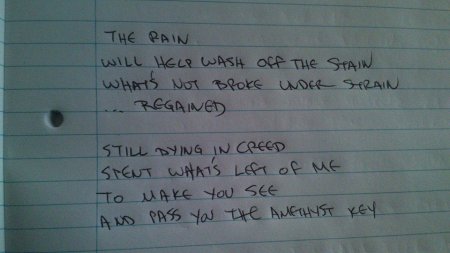
The lyrics explore the tragedy of the human condition, focusing in particular on the turmoil of turbulent and toxic relationships. They reflect the all-too-familiar impulse to cling to the hope that things can be ‘made to work’ even when the warning signs are unmistakable and the emotional damage is already well underway.
The title Amethyst is drawn from the Greek myth of the virgin Amethyst, who is transformed into crystal to protect her from the hedonistic god of intoxication, Dionysus—often portrayed, in later interpretations and especially in Euripides’ Bacchae, as a force of ecstatic excess with Eastern (Persian) associations.
For a more detailed discussion of the song’s themes and the symbolic imagery woven into the lyrics, follow the link below:
Marios Papakostas, who had been deeply familiar with the debut album even before officially joining the band, encouraged me to write a song that could match Ibidem stylistically. This was somewhat at odds with his earlier position, which had been to avoid using existing songs as templates or following fixed formulas. In that sense, I suppose I subconsciously granted that request with Amethyst. Much like Ibidem, the song features brief hook-driven surges before building toward a climax that resolves in a coda—that is, a completely new musical theme introduced after an instrumental bridge that partially releases, but does not fully resolve, the tension established in the verses.
This kind of narrative-driven structure is something we’re particularly drawn to, and we tend to avoid standard pop-song formats whenever possible—unless a song genuinely calls for one. Early on, some people in the industry urged us to include more choruses, or more solos, and so on, often suggesting that we “weren’t Tool” and therefore couldn’t get away with this approach. But leaning too heavily on formula would never have felt natural or honest to who we are as a band.
I remember bringing the two main sections of the song into the rehearsal space, where Damos immediately came up with these incredible bass lines. As always, he managed to make me question the years I once thought I was a competent bass player, effortlessly shaping the finer details on the spot – including the closing riff.

Although we weren’t fully satisfied with the production—the mix felt overly busy, with too many elements competing within the same frequency ranges, an issue we initially failed to address—the song still went on to receive very positive reviews. It is also accompanied by an evocative lyric video created by Afsoon Shahriari, who also designed the original single artwork and has been responsible for much of the visual work produced for Phase.
The original cover featured the ‘Amethyst Key’, a symbol of wisdom, clarity, and spiritual insight in the context of the song. It was partly buried on a long, expansive beach at low tide, reminiscent of the East coast of Northern England, where the low tide reveals miles of walkable sand stretching towards the sea. For the remastered release, we recreated this concept using an antique skeleton key purchased at Tynemouth market, onto which we glued an Amethyst crystal. The key is fully uncovered for this one (or Resurfaced) with the tide coming in, whilst the photograph was taken at Whitley Bay, if I recall correctly. The Layout and Colour Correction was done by Aris Liapis on both versions.
Mark Chudnovskyi, with the exceptional skills of a miracle worker, took on the challenging task of creating a more balanced stereo image for the song over 10 years later. He focused on enhancing the sound without over-processing it, aiming to remain faithful to the original recordings. We feel that the result preserves the authenticity and emotional connection to that era, whilst it lends the song a new lease of life.
I really hope you enjoyed this one in whatever version or form,
Thanos


 Phaseship - The Phase Archives
One Comment Add yours