Hypoxia emerged on the back of sorting and working on the first lot of riffs I had written for Phase. I remember working on the song on two different occasions, once in 2004 with Chris Gioldasis and once later around 2006-2007 with Damos way before we ended up actually playing together, but either attempts were not particularly fruitful.
You also might be interested to know that every time Hypoxia is played back an audiophile dies. This statement would perhaps warrant further explanation:
Something we never had told anyone up till now, just because the occasion did not arise (inside joke alert!), is that by the time we were finalising In Consequence we had already suffered two or three ‘mass extinction events’ where all of our data were wiped, and the band also sustained a prolonged mental health crisis setback in its circles.
In the first decade of 2000 affordable Intel Pentium systems were all over the place in Greece, often comprised of incompatible with their motherboard, cheap components, and at the same time backup solutions were still relatively bulky and expensive.
The system I had recorded Perdition, amongst other things, on, as early as 2004 (that project thankfully survived as it was transferred using an external solution as part of some file exchange), has what I suspected to be a failing SRD memory module, giving me blue screens of death, as by unplugging it and plugging it back onto the motherboard the system appeared to boot normally.
‘no one escapes the legendary Blue Screen of Death‘


My cousin who used to teach IT in the local (then) polytech, introduced me to a student of his who was alleged to be a highly commendable technician. I trusted the machine to them and left it at their shop with clear instructions. It turns out the computer needed its little stroll to come to its senses, and it happened to switch on for the technology guru who thought formatting that, was a genius idea, instead of backing it up.
As a result, I’ve literally lost hundreds of lyrical and musical ideas, including fully finished songs (I’m not pulling a Kirk Hammet here with his lost phone story, I still have hundreds of ideas shelved despite starting over!). I haven’t been more upset in my entire life and the technician who would only have seen me for the second time in his life also gathered that this was the case, and did not charge me for his time in his desperate attempts to de-escalate the situation.
The computer eventually met its demise (with the HD also becoming unsalvageable in the end), even after having several parts, including its motherboard replaced at a shop recommended to me by Chris Gioldasis, who was dealing with similar issues at the time and was already quite seasoned regarding such matters. On a side note, the shop owner also ran an internet café where I used to do some work, which led to many of the deals we secured during the band’s early days.
My late friend Labros Vasilos used to call my computer Euclid in jest after the homonymous computer in Darren Arronovsκy‘s ‘π’, and that’s when jokes about my unusually bad luck with technology started.
Alex Arnaoutoglou‘s hard drive also failed at some point, and just because it had taken us an awful long by that time and were sick on the process, we used an .mp3 (albeit ‘lossless’) stereo mixdown we had of Hypoxia and added parts on it. We really felt it was peak performance and kept that as it felt like a good idea at the time.
Needless to say, people we know who are all about analog recordings, tubes, and tape loved the way it sounds. And even Charles Manson himself, the epitome of the frustrated 60s musician loved it (fact)!

Stergios Kokoltsis who mastered the album, nearly pissed himself laughing when he saw the waveform as the song loaded on his DAW / mastering suite and we subsequently explained what had transpired.
As far as the other, mentioned in passing, event that took place in the interim; it was captured in the song’s lyrics and also made me forever interested in psychology, and psychological realism in art.
The Lyrics
The song explores themes of inner conflict, emotional repression, and the search for self-understanding.
It delves into the tension between one’s authentic self and the façade presented to the world, echoing Jean-Paul Sartre’s concept of living in ‘bad faith’. The narrator persistently suppresses their emotions, resulting in numbness, suffocation, and confusion. Despite a strong desire to break free from these internal constraints, they feel powerless; amplifying a sense of frustration and helplessness.
The lyrics are vituperative, marked by a fierce, self-directed anger that borders on emotional self-flagellation. The main narrative voice may reflect someone who fundamentally misunderstands social reality and internalises this confusion as personal failure. This misunderstanding seems to feed a harsh inner critic, relentless and unforgiving, exacerbating the sense of disconnection and alienation.
The tone is introspective and tinged with desperation, while the mood remains heavy, reflecting the crushing weight of inner turmoil. The final line, ‘I can’t breathe’ encapsulates the hopelessness and overwhelming nature of the narrator’s internal struggle. It vividly portrays someone caught in a cycle of self-denial; yearning for authenticity, yet continually thwarted by their own emotional defences.
While the album as a whole can be viewed as steeped in the weight of teenage angst (and is certainly written from that perspective) it does not adopt a definitive stance on existentialism; it perhaps at times counterproductively, is just filled with existential dread, ultimately serving as a non flattering mirror for those that can identify. Since writing it, I’ve gone on to study Sartre more deeply, as part of a University degree and I genuinely believe he would score quite highly on an autism assessment, based on some of the thoughts he enlosed on Being and Nothingness. He, perhaps much like the song’s narrator, often seemed troubled by social conventions and overlooked the more obvious nuances. Sadly, he missed that train, and with it, potentially, the chance to experience a less conflicted inner life. But then again, it’s always easier to argue with and criticise, the dead.
In any case, I find myself aligned with a relevant Slavoj Žižek’s Lacanian interpretation. As he explains in The Pervert’s Guide series, when you strip away the fantasy that supports reality, you’re not left with ‘reality’ in any pure and actual sense, but rather a nightmarish, alternate dimension, which in my view is what could have happened to the song’s narrator.
On Art and Artists
The line run but you can’t hide is a transtextual reference to Placebo‘s Infrared (There is no running that can hide you), that in turn references Depeche Mode‘s It’s No Good (You can run but you cannot hide); both being favourite acts of mine.
I find the concepts of intertextuality and intersemiocity to be very interesting and I place particular importance on those in terms of the way we present our output.
Depeche Mode and Placebo are both bands I had serious objections about how they chose to present/promote their output, and especially for the latter, I have previously been vocal about how they seem to have ridden the wave of advocating for a hip counterculture/pressure group for their own advantage.
It’s not uncommon for artists to engage in similar behaviours, but some such expressions can be more groundbreaking than others. Acts like the the Rolling Stones and Led Zeppelin embraced a liberal, hypersexualised image that aligned with the sexual revolution of their era. Similarly, David Bowie who, incidentally discovered and helped promote Placebo in their early days, adopted an androgynous persona during a period that overlapped with the decriminalisation of homosexuality in England and Wales. This wasn’t entirely dissimilar to what t.A.T.u. later did in Russia. However, one could argue that there are varied degrees of what could be perceived as pretentiousness in the above examples, as much as it is an act of raising awareness and actively promoting public discourse around important societal matters.
There’s always a zeitgeist and artists are inevitably perceiving and capturing that, them also being a product of their environment, but part of the above expressions could perhaps constitute jumping on the bandwagon for attention-seeking, presented as having a noble cause or just an assumed revolutionary attitude towards life.
But then again, maybe you gotta do what you gotta do to put the message out there, a bit like what Nietzsche said about all great things needing to wear masks in order to inscribe themselves in the consciousness of humanity.
I don’t know what the answer is to this one, or where the fine line is, so I’ll get back to you on that.
All of the above however, serve as a nice segway to the line that comes right after in the song, as the above references were consciously paired with a Michael Jackson reference.
People v Jackson
[…] you’d better think twice, is perhaps a bit more covert of a lyrical reference that the previously mentioned ones, but I definitely took Michael Jackson‘s strong advice on that one.
In gigs we sometimes used the backing vocal response Do think twice following the line, and on the acoustic version of Hypoxia on the middle section the Saint is sometimes playing the theme to Home Alone as a mash-up, owing to Macaulay Culkin‘s controversial, albeit platonic in his own evidence, playdates with the King of Pop.


Around the time the lyrics for Hypoxia were put together, Michael Jackson happened to have died, and I noticed the very apparent effect of the idolisation and mere exposure phenomena in real-time, as well as a revival of the persona(lity) cult.


Many people who never examined the evidence behind the past allegations against Michael Jackson, formed very strong opinions about him and his conduct, assuming his genuinely innocent and honest interest in children, and how he was the target of false allegations and a victim of extortion (despite every relationship of the star being transactional, and his entourage displaying real elements of opportunism, it doesn’t not exclude or forgive any form of child abuse perpetrated by him) all while occupying prime positions in the court of public opinion.
This led me to me observe in its full depth, the truth that people who tend to make excuses for themselves are often quick to support an extreme example of that same behaviour. It’s similar to how some people reshape and vernacularise religion -or any genuinely held philosophical ideas for that matter – to fit their own worldview. This can range from believing in far-fetched notions that ignore common sense and established science, like the idea that the Earth is flat or that Queen Elizabeth II was a lizard.
People who barely knew MJs body of work, suddenly found themselves buying his records and merchandise, calling him an artistic genius and the GOAT (to be down with the kids), also expressing an unusual level of sadness over his death – in cases showing more grief than they had for people they actually knew who were sick or had passed away.
Relatedly, Michael Jackson sold 35 million albums within the year following his death, which is the most in the soundscan era. Michael Jackson‘s This Is It! was released a few months following his death and apparently is still the top-grossing concert film and documentary film of all time.
To me, Michael Jackson was always some kind of Messiah for the Narcissists (or more accurately the emotionally immature, with empathy levels expected to be displayed by a toddler, as the term has been somewhat glamourised by people self-labeling themselves as such, thinking that it adds to their misplaced sense of grandeur). The boy that never grew up, exactly like Peter Pan he identified with (going as far as naming his elaborate heaven on earth for children playground/ranch, Neverland).
I remember when Martin Bashir interviewed him for Living with Michael Jackson he admitted to having surgery only after insistent probing, attempted to convince him that he was a virgin/celibate and that the surrogate mother he had his ‘biological’ fair children with (implying not just gestational but also donating the egg for the IVF) was also black (and who would be expected to remain black for her whole life unlike the self-attributed to vitiligo transracial miracle that was MJ) insulting reality and defying all the progress of scientific understanding in regards to genetics, coming a long way from Darwin and Mendel. During the same interview, he also went on to say that it is not weird for anyone’s children to have unsupervised sleepovers, sharing a bed with a random (albeit infamous and therefore bizarrely familiar) 40-year-old, who was ‘mostly sleeping on the floor himself, gave them blankets and hot milk’. Real skin-crawling material! Shamone on you Michael!

Wacko Jacko*‘s conditions, including his body dysmorphic disorder, and his, widely debated, disturbing attraction to prepubescent children, likely stem from his own trauma and adverse childhood experiences – such as physical, emotional, financial, and sexual abuse predominantly perpetrated by his own father, as his sister LaToya was explaining in the 90s, trying to scream some sense before she retracted her statements (and rebuilding her relationship with her brother, by reframing those statements as a result of her then partner’s to extort him), or as MJ‘s apologists would say, trying to promote herself. Interestingly, as Damos had pointed out to me, when Joe Jackson was approached for a comment on his son’s death he didn’t really seem bothered and moved on to plugging artists on his label – arguably the Jackson’s were far from the most functional family.
But where do we draw the line on what kind of behaviour trauma excuses? And can we truly separate the art from the artist and absolve them of their disturbing paradigm, when idolisation can trick people into thinking that their idols are always right?
I personally think that a world where he would be encouraged to address his issues would be a world that I would want to live in, and I wouldn’t miss Smooth Criminal, Beat It or Bad for a second hadn’t they had ever been recorded, although I understand some regard those as masterpieces, despite my inability to get the appeal other than the fact they have been, as they still are, nauseously over-promoted.
It felt that a song about denial, unaddressed trauma and inner struggle would be matching to feature an indirect reference to its ever-glorified poster boy.


For the initiated, an in-depth analysis of the lyrics can be found by following the link below:
https://genius.com/Phase-hypoxia-lyrics
Moving Pictures
We set out to create a music video filmed and edited by Aris Liapis around 2013, and guess what happened to his Hard Drive…


A few years later, Shayda Alizadeh, an Iranian filmmaker living in Australia had asked for permission to use the song for a university project that was showcased in festivals, but we really didn’t push this thinking it might come across as sexist, as it features a lady pole dancing, wearing the absolutely necessary, but it turns out that in the 2020s that is actually feminist, and empowering, but behind that oversimplification there’s a different altogether, long conversation for some other time.
Find the plot summary on IMDb by following the link below:
https://www.imdb.com/title/tt34541044/plotsummary/
Festivals this has been showcased include:
-Official Selection: Visionaria – 2017
-Official Selection: Short Film Roosendaal – 2017
-Official Selection: Sarajevo Fashion Film Festival – 2017
-Official Selection: Finpret International Film Festival – 2018
Till next time,
Thanos
*Wacko Jacko was a nickname given to Michael Jackson by tabloids in the 1980s. He labelled it a racist slur to shut it down, as the era wasn’t particularly sensitive to language surrounding mental health, and maybe the term Wacko was especially difficult to tackle at the time this being a useful insight in terms of the social attitudes on the matter at the time. Jackson sought to establish an unlikely connection between the derogatory nickname and Jacco Macacco a 19th-century fighting monkey exhibited in brutal monkey-baiting matches at Westminster Pit, suggesting the nickname might have racist undertones rooted in that association, due to the long dark history of black people being compared to to apes and monkeys – animalisation being a widespread element of racist dehumanisation. Obviously, this is a stretch as Jacko is a nickname deriving from MJ‘s last name, like McCartney would be called Macca, or Sharon, Shazza and so on, and it shows the lengths he was prepared to go with his justifications.

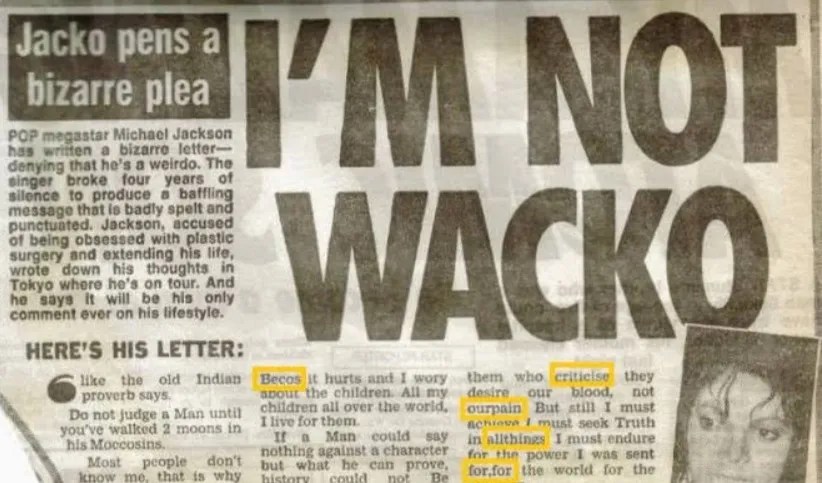
This tenuous attempt was perhaps another example of Jackson’s propensity to confabulate, much like his claims that his dramatic skin colour change was due solely to vitiligo – a stretch by anyone’s standards; whilst he later tried to ‘defend’ himself on the matter by criticising the multimillion-pound sunscreen industry and pointing out that no one attacks people for displaying the opposite desire to his, herein, wanting to get tanned. ‘Living inside a lie, suppressing the truth -denying’.
 Phaseship - The Phase Archives
One Comment Add yours